
Newest


Stake Hinged Ring
Stake Hinged Ring
1.2mm x 8mm
Manufactured out of Implant Grade Titanium (Ti-6AL-4V-ELI ASTM F136)


24kt Gold PVD Titanium Flared Marquise Hinged Ring
24kt Gold PVD Titanium Flared Marquise Hinged Ring
1.2mm x 10mm
Manufactured out of Implant Grade Titanium (Ti-6AL-4V-ELI ASTM F136)
PVD (Vacuum coating), also known as thin-film deposition, is a vacuum chamber process whereby a very thin and steady layer of coating is applied to the titanium surface of a substrate, protecting it from forces that might wear it down or decrease its efficiency.
PVD Coating isn’t adding another layer to the object that will chip or crack with time (think old paint).
PVD coating is becoming a standard for medical tools. The coating reduces friction, provides biocompatibility for implants, is antimicrobial, and it serves as a chemical barrier for those with a sensitivity to nickel (which can often be found in the tool).
As opposed to other coatings that chip, crack, and wear down, vacuum coatings are a shining armor for your jewelry, providing a strong and thin coating for a variety of applications.
Unlike paints which other companies use and many other methods, this technique is body-friendly so it can be used safely and without a problem.


Flared Marquise Hinged Ring
Flared Marquise Hinged Ring
1.2mm x 10mm
Manufactured out of Implant Grade Titanium (Ti-6AL-4V-ELI ASTM F136)


24kt Gold PVD Titanium Jeweled Thick Spike Hinged Ring
24kt Gold PVD Titanium Jeweled Thick Spike Hinged Ring
1.2mm x 8mm
Manufactured out of Implant Grade Titanium (Ti-6AL-4V-ELI ASTM F136)
PVD (Vacuum coating), also known as thin-film deposition, is a vacuum chamber process whereby a very thin and steady layer of coating is applied to the titanium surface of a substrate, protecting it from forces that might wear it down or decrease its efficiency.
PVD Coating isn’t adding another layer to the object that will chip or crack with time (think old paint).
PVD coating is becoming a standard for medical tools. The coating reduces friction, provides biocompatibility for implants, is antimicrobial, and it serves as a chemical barrier for those with a sensitivity to nickel (which can often be found in the tool).
As opposed to other coatings that chip, crack, and wear down, vacuum coatings are a shining armor for your jewelry, providing a strong and thin coating for a variety of applications.
Unlike paints which other companies use and many other methods, this technique is body-friendly so it can be used safely and without a problem.


Jeweled Thick Spike Hinged Ring
Jeweled Thick Spike Hinged Ring
1.2mm x 8mm
Manufactured out of Implant Grade Titanium (Ti-6AL-4V-ELI ASTM F136)


24kt Gold PVD Titanium Forward Facing Jeweled Marquise Hinged Ring
24kt Gold PVD Titanium Forward Facing Jeweled Marquise Hinged Ring
1.2mm x 8mm
Manufactured out of Implant Grade Titanium (Ti-6AL-4V-ELI ASTM F136)
PVD (Vacuum coating), also known as thin-film deposition, is a vacuum chamber process whereby a very thin and steady layer of coating is applied to the titanium surface of a substrate, protecting it from forces that might wear it down or decrease its efficiency.
PVD Coating isn’t adding another layer to the object that will chip or crack with time (think old paint).
PVD coating is becoming a standard for medical tools. The coating reduces friction, provides biocompatibility for implants, is antimicrobial, and it serves as a chemical barrier for those with a sensitivity to nickel (which can often be found in the tool).
As opposed to other coatings that chip, crack, and wear down, vacuum coatings are a shining armor for your jewelry, providing a strong and thin coating for a variety of applications.
Unlike paints which other companies use and many other methods, this technique is body-friendly so it can be used safely and without a problem.


Forward Facing Jeweled Marquise Hinged Ring
Forward Facing Jeweled Marquise Hinged Ring
1.2mm x 8mm
Manufactured out of Implant Grade Titanium (Ti-6AL-4V-ELI ASTM F136)


24kt Gold PVD Titanium Forward Facing Diamond Hinged Ring
24kt Gold PVD Titanium Forward Facing Diamond Hinged Ring
1.2mm x 8mm
Manufactured out of Implant Grade Titanium (Ti-6AL-4V-ELI ASTM F136)
PVD (Vacuum coating), also known as thin-film deposition, is a vacuum chamber process whereby a very thin and steady layer of coating is applied to the titanium surface of a substrate, protecting it from forces that might wear it down or decrease its efficiency.
PVD Coating isn’t adding another layer to the object that will chip or crack with time (think old paint).
PVD coating is becoming a standard for medical tools. The coating reduces friction, provides biocompatibility for implants, is antimicrobial, and it serves as a chemical barrier for those with a sensitivity to nickel (which can often be found in the tool).
As opposed to other coatings that chip, crack, and wear down, vacuum coatings are a shining armor for your jewelry, providing a strong and thin coating for a variety of applications.
Unlike paints which other companies use and many other methods, this technique is body-friendly so it can be used safely and without a problem.


Forward Facing Jeweled Diamond Hinged Ring
Forward Facing Jeweled Diamond Hinged Ring
Manufactured out of Implant Grade Titanium (Ti-6AL-4V-ELI ASTM F136)


24kt Gold PVD Titanium Drip Hinged Ring
24kt Gold PVD Titanium Drip Hinged Ring
1.2mm x 10mm
Manufactured out of Implant Grade Titanium (Ti-6AL-4V-ELI ASTM F136)
PVD (Vacuum coating), also known as thin-film deposition, is a vacuum chamber process whereby a very thin and steady layer of coating is applied to the titanium surface of a substrate, protecting it from forces that might wear it down or decrease its efficiency.
PVD Coating isn’t adding another layer to the object that will chip or crack with time (think old paint).
PVD coating is becoming a standard for medical tools. The coating reduces friction, provides biocompatibility for implants, is antimicrobial, and it serves as a chemical barrier for those with a sensitivity to nickel (which can often be found in the tool).
As opposed to other coatings that chip, crack, and wear down, vacuum coatings are a shining armor for your jewelry, providing a strong and thin coating for a variety of applications.
Unlike paints which other companies use and many other methods, this technique is body-friendly so it can be used safely and without a problem.


Drip Hinged Ring
Drip Hinged Ring
1.2mm x 10mm
Manufactured out of Implant Grade Titanium (Ti-6AL-4V-ELI ASTM F136)


24kt Gold PVD Titanium Internally Threaded 1 Drop Navel
24kt Gold PVD Titanium Internally Threaded 1 Drop Navel
1.6mm x 10mm
Internally Threaded Manufactured out of Implant Grade Titanium (Ti-6AL-4V-ELI ASTM F136)
PVD (Vacuum coating), also known as thin-film deposition, is a vacuum chamber process whereby a very thin and steady layer of coating is applied to the titanium surface of a substrate, protecting it from forces that might wear it down or decrease its efficiency.
PVD Coating isn’t adding another layer to the object that will chip or crack with time (think old paint).
PVD coating is becoming a standard for medical tools. The coating reduces friction, provides biocompatibility for implants, is antimicrobial, and it serves as a chemical barrier for those with a sensitivity to nickel (which can often be found in the tool).
As opposed to other coatings that chip, crack, and wear down, vacuum coatings are a shining armor for your jewelry, providing a strong and thin coating for a variety of applications.
Unlike paints which other companies use and many other methods, this technique is body-friendly so it can be used safely and without a problem.


24kt Gold PVD Titanium Internally Threaded 2 Drop Navel
24kt Gold PVD Titanium Internally Threaded 2 Drop Navel
1.6mm x 10mm
Internally Threaded Manufactured out of Implant Grade Titanium (Ti-6AL-4V-ELI ASTM F136)
PVD (Vacuum coating), also known as thin-film deposition, is a vacuum chamber process whereby a very thin and steady layer of coating is applied to the titanium surface of a substrate, protecting it from forces that might wear it down or decrease its efficiency.
PVD Coating isn’t adding another layer to the object that will chip or crack with time (think old paint).
PVD coating is becoming a standard for medical tools. The coating reduces friction, provides biocompatibility for implants, is antimicrobial, and it serves as a chemical barrier for those with a sensitivity to nickel (which can often be found in the tool).
As opposed to other coatings that chip, crack, and wear down, vacuum coatings are a shining armor for your jewelry, providing a strong and thin coating for a variety of applications.
Unlike paints which other companies use and many other methods, this technique is body-friendly so it can be used safely and without a problem.


24kt Gold PVD Titanium Threadless Curved with Chain and Clear Stone Attachment
24kt Gold PVD Titanium Threadless Curved with Chain and Clear Stone Attachment
Manufactured out of Implant Grade Titanium (Ti-6AL-4V-ELI ASTM F136)
Threadless Jewelry Method:
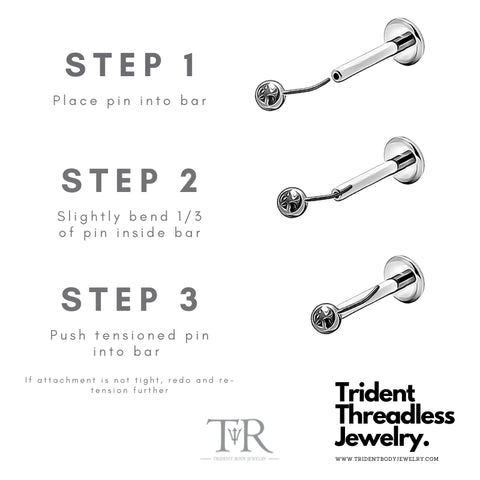
Threadless jewelry is tensioned by using the end of the attachment and bending it within the bar to hold into place. To create the tension insert the pin on the end of the attachment slightly into the bar and bend slightly. Once inserted into the bar the bend in the pin should create the tension needed to hold into place. Direction below:
- Insert the pin on the end of the attachment 1/4 - 1/3 into the bar. (Labret, barbell etc.)
- Slightly bend the insertion pin within the bar.
- Push the end into the shaft and test the fit.
Insuring the fit: Insure the attachment is held in place and is tight. Adjust as necessary, if the pin does not hold tight enough redo the steps & create more tension.


24kt Gold PVD Titanium Threadless Curved with Chain Attachment
24kt Gold PVD Titanium Threadless Curved with Chain Attachment
Manufactured out of Implant Grade Titanium (Ti-6AL-4V-ELI ASTM F136)
Threadless Jewelry Method:
Threadless jewelry is tensioned by using the end of the attachment and bending it within the bar to hold into place. To create the tension insert the pin on the end of the attachment slightly into the bar and bend slightly. Once inserted into the bar the bend in the pin should create the tension needed to hold into place. Direction below:
- Insert the pin on the end of the attachment 1/4 - 1/3 into the bar. (Labret, barbell etc.)
- Slightly bend the insertion pin within the bar.
- Push the end into the shaft and test the fit.
Insuring the fit: Insure the attachment is held in place and is tight. Adjust as necessary, if the pin does not hold tight enough redo the steps & create more tension.


Threadless Curved with Chain and Clear Stone Attachment
Threadless Curved with Chain and Clear Stone Attachment
Manufactured out of Implant Grade Titanium (Ti-6AL-4V-ELI ASTM F136)
Threadless Jewelry Method:
Threadless jewelry is tensioned by using the end of the attachment and bending it within the bar to hold into place. To create the tension insert the pin on the end of the attachment slightly into the bar and bend slightly. Once inserted into the bar the bend in the pin should create the tension needed to hold into place. Direction below:
- Insert the pin on the end of the attachment 1/4 - 1/3 into the bar. (Labret, barbell etc.)
- Slightly bend the insertion pin within the bar.
- Push the end into the shaft and test the fit.
Insuring the fit: Insure the attachment is held in place and is tight. Adjust as necessary, if the pin does not hold tight enough redo the steps & create more tension.


Threadless Curved with Chain Attachment
Threadless Curved with Chain Attachment
Manufactured out of Implant Grade Titanium (Ti-6AL-4V-ELI ASTM F136)
Threadless Jewelry Method:
Threadless jewelry is tensioned by using the end of the attachment and bending it within the bar to hold into place. To create the tension insert the pin on the end of the attachment slightly into the bar and bend slightly. Once inserted into the bar the bend in the pin should create the tension needed to hold into place. Direction below:
- Insert the pin on the end of the attachment 1/4 - 1/3 into the bar. (Labret, barbell etc.)
- Slightly bend the insertion pin within the bar.
- Push the end into the shaft and test the fit.
Insuring the fit: Insure the attachment is held in place and is tight. Adjust as necessary, if the pin does not hold tight enough redo the steps & create more tension.


24kt Gold PVD Titanium Threadless Prong Set Heart Attachment
24kt Gold PVD Titanium Threadless Prong Set Heart Attachment
Manufactured out of Implant Grade Titanium (Ti-6AL-4V-ELI ASTM F136)
Threadless Jewelry Method:
Threadless jewelry is tensioned by using the end of the attachment and bending it within the bar to hold into place. To create the tension insert the pin on the end of the attachment slightly into the bar and bend slightly. Once inserted into the bar the bend in the pin should create the tension needed to hold into place. Direction below:
- Insert the pin on the end of the attachment 1/4 - 1/3 into the bar. (Labret, barbell etc.)
- Slightly bend the insertion pin within the bar.
- Push the end into the shaft and test the fit.
Insuring the fit: Insure the attachment is held in place and is tight. Adjust as necessary, if the pin does not hold tight enough redo the steps & create more tension.


24kt Gold PVD Titanium Threadless Prong Set Star Attachment
24kt Gold PVD Titanium Threadless Prong Set Star Attachment
Manufactured out of Implant Grade Titanium (Ti-6AL-4V-ELI ASTM F136)
Threadless Jewelry Method:
Threadless jewelry is tensioned by using the end of the attachment and bending it within the bar to hold into place. To create the tension insert the pin on the end of the attachment slightly into the bar and bend slightly. Once inserted into the bar the bend in the pin should create the tension needed to hold into place. Direction below:
- Insert the pin on the end of the attachment 1/4 - 1/3 into the bar. (Labret, barbell etc.)
- Slightly bend the insertion pin within the bar.
- Push the end into the shaft and test the fit.
Insuring the fit: Insure the attachment is held in place and is tight. Adjust as necessary, if the pin does not hold tight enough redo the steps & create more tension.


Threadless Prong Set Star Attachment
Threadless Prong Set Star Attachment
Manufactured out of Implant Grade Titanium (Ti-6AL-4V-ELI ASTM F136)
Threadless Jewelry Method:
Threadless jewelry is tensioned by using the end of the attachment and bending it within the bar to hold into place. To create the tension insert the pin on the end of the attachment slightly into the bar and bend slightly. Once inserted into the bar the bend in the pin should create the tension needed to hold into place. Direction below:
- Insert the pin on the end of the attachment 1/4 - 1/3 into the bar. (Labret, barbell etc.)
- Slightly bend the insertion pin within the bar.
- Push the end into the shaft and test the fit.
Insuring the fit: Insure the attachment is held in place and is tight. Adjust as necessary, if the pin does not hold tight enough redo the steps & create more tension.


Threadless Prong Set Heart Attachment
Threadless Prong Set Heart Attachment
Manufactured out of Implant Grade Titanium (Ti-6AL-4V-ELI ASTM F136)
Threadless Jewelry Method:
Threadless jewelry is tensioned by using the end of the attachment and bending it within the bar to hold into place. To create the tension insert the pin on the end of the attachment slightly into the bar and bend slightly. Once inserted into the bar the bend in the pin should create the tension needed to hold into place. Direction below:
- Insert the pin on the end of the attachment 1/4 - 1/3 into the bar. (Labret, barbell etc.)
- Slightly bend the insertion pin within the bar.
- Push the end into the shaft and test the fit.
Insuring the fit: Insure the attachment is held in place and is tight. Adjust as necessary, if the pin does not hold tight enough redo the steps & create more tension.


24kt Gold PVD Titanium Round Cluster Jeweled Hinged Ring
24kt Gold PVD Titanium Round Cluster Jeweled Hinged Ring
1.2mm x 8mm
Manufactured out of Implant Grade Titanium (Ti-6AL-4V-ELI ASTM F136)
PVD (Vacuum coating), also known as thin-film deposition, is a vacuum chamber process whereby a very thin and steady layer of coating is applied to the titanium surface of a substrate, protecting it from forces that might wear it down or decrease its efficiency.
PVD Coating isn’t adding another layer to the object that will chip or crack with time (think old paint).
PVD coating is becoming a standard for medical tools. The coating reduces friction, provides biocompatibility for implants, is antimicrobial, and it serves as a chemical barrier for those with a sensitivity to nickel (which can often be found in the tool).
As opposed to other coatings that chip, crack, and wear down, vacuum coatings are a shining armor for your jewelry, providing a strong and thin coating for a variety of applications.
Unlike paints which other companies use and many other methods, this technique is body-friendly so it can be used safely and without a problem.


Round Cluster Jeweled Hinged Ring
Round Cluster Jeweled Hinged Ring
1.2mm x 8mm
Manufactured out of Implant Grade Titanium (Ti-6AL-4V-ELI ASTM F136)


24kt Gold PVD Titanium Diamond Cluster Jeweled Hinged Ring
24kt Gold PVD Titanium Diamond Cluster Jeweled Hinged Ring
1.2mm x 8mm
Manufactured out of Implant Grade Titanium (Ti-6AL-4V-ELI ASTM F136)
PVD (Vacuum coating), also known as thin-film deposition, is a vacuum chamber process whereby a very thin and steady layer of coating is applied to the titanium surface of a substrate, protecting it from forces that might wear it down or decrease its efficiency.
PVD Coating isn’t adding another layer to the object that will chip or crack with time (think old paint).
PVD coating is becoming a standard for medical tools. The coating reduces friction, provides biocompatibility for implants, is antimicrobial, and it serves as a chemical barrier for those with a sensitivity to nickel (which can often be found in the tool).
As opposed to other coatings that chip, crack, and wear down, vacuum coatings are a shining armor for your jewelry, providing a strong and thin coating for a variety of applications.
Unlike paints which other companies use and many other methods, this technique is body-friendly so it can be used safely and without a problem.


Diamond Cluster Jeweled Hinged Ring
Diamond Cluster Jeweled Hinged Ring
1.2mm x 8mm
Manufactured out of Implant Grade Titanium (Ti-6AL-4V-ELI ASTM F136)


24kt Gold PVD Titanium Moon Face Hinged Ring
24kt Gold PVD Titanium Moon Face Hinged Ring
1.2mm x 8mm
Manufactured out of Implant Grade Titanium (Ti-6AL-4V-ELI ASTM F136)
PVD (Vacuum coating), also known as thin-film deposition, is a vacuum chamber process whereby a very thin and steady layer of coating is applied to the titanium surface of a substrate, protecting it from forces that might wear it down or decrease its efficiency.
PVD Coating isn’t adding another layer to the object that will chip or crack with time (think old paint).
PVD coating is becoming a standard for medical tools. The coating reduces friction, provides biocompatibility for implants, is antimicrobial, and it serves as a chemical barrier for those with a sensitivity to nickel (which can often be found in the tool).
As opposed to other coatings that chip, crack, and wear down, vacuum coatings are a shining armor for your jewelry, providing a strong and thin coating for a variety of applications.
Unlike paints which other companies use and many other methods, this technique is body-friendly so it can be used safely and without a problem.


Moon Face Hinged Ring
Moon Face Hinged Ring
1.2mm x 8mm
Manufactured out of Implant Grade Titanium (Ti-6AL-4V-ELI ASTM F136)


24kt Gold PVD Titanium Forward Facing Jeweled Spike Hinged Ring
24kt Gold PVD Forward Facing Jeweled Spike Hinged Ring
1.2mm x 8mm
Manufactured out of Implant Grade Titanium (Ti-6AL-4V-ELI ASTM F136)
PVD (Vacuum coating), also known as thin-film deposition, is a vacuum chamber process whereby a very thin and steady layer of coating is applied to the titanium surface of a substrate, protecting it from forces that might wear it down or decrease its efficiency.
PVD Coating isn’t adding another layer to the object that will chip or crack with time (think old paint).
PVD coating is becoming a standard for medical tools. The coating reduces friction, provides biocompatibility for implants, is antimicrobial, and it serves as a chemical barrier for those with a sensitivity to nickel (which can often be found in the tool).
As opposed to other coatings that chip, crack, and wear down, vacuum coatings are a shining armor for your jewelry, providing a strong and thin coating for a variety of applications.
Unlike paints which other companies use and many other methods, this technique is body-friendly so it can be used safely and without a problem.


Forward Facing Jeweled Spike Hinged Ring
Forward Facing Jeweled Spike Hinged Ring
1.2mm x 8mm
Manufactured out of Implant Grade Titanium (Ti-6AL-4V-ELI ASTM F136)


Black PVD Titanium Barbed Wire Hinged Ring
Black PVD Titanium Barbed Wire Hinged Ring
1.2mm x 8mm
Internally Threaded Titanium Manufactured out of Implant Grade Titanium (Ti-6AL-4V-ELI ASTM F136)
PVD (Vacuum coating), also known as thin-film deposition, is a vacuum chamber process whereby a very thin and steady layer of coating is applied to the surface of a substrate, protecting it from forces that might wear it down or decrease its efficiency.
PVD Coating isn’t adding another layer to the object that will chip or crack with time (think old paint). It’s impregnating the object.
Black titanium nitride applied via PVD coating is becoming a standard for medical tools. The coating reduces friction, provides biocompatibility for implants, is antimicrobial, and it serves as a chemical barrier for those with a sensitivity to nickel (which can often be found in the tool).
As opposed to other coatings that chip, crack, and wear down, vacuum coatings are a shining armor for your jewelry, providing a strong and thin coating for a variety of applications.
Unlike paints which other companies use and many other methods, this technique is body-friendly so it can be used safely and without a problem


24kt Gold PVD Titanium Barbed Wire Hinged Ring
24kt Gold PVD Titanium Barbed Wire Hinged Ring
1.2mm x 8mm
Manufactured out of Implant Grade Titanium (Ti-6AL-4V-ELI ASTM F136)
PVD (Vacuum coating), also known as thin-film deposition, is a vacuum chamber process whereby a very thin and steady layer of coating is applied to the titanium surface of a substrate, protecting it from forces that might wear it down or decrease its efficiency.
PVD Coating isn’t adding another layer to the object that will chip or crack with time (think old paint).
PVD coating is becoming a standard for medical tools. The coating reduces friction, provides biocompatibility for implants, is antimicrobial, and it serves as a chemical barrier for those with a sensitivity to nickel (which can often be found in the tool).
As opposed to other coatings that chip, crack, and wear down, vacuum coatings are a shining armor for your jewelry, providing a strong and thin coating for a variety of applications.
Unlike paints which other companies use and many other methods, this technique is body-friendly so it can be used safely and without a problem.


Barbed Wire Hinged Ring
Barbed Wire Hinged Ring
1.2mm x 8mm
Manufactured out of Implant Grade Titanium (Ti-6AL-4V-ELI ASTM F136)